What Is the Alabama Small Estates Act?
The Alabama Small Estates Act (codified at Ala. Code §§ 43-2-690 et seq.) allows qualifying estates to bypass the full probate administration process through a simplified procedure called summary distribution. Instead of months of court filings, creditor notices, accountings, and final settlement hearings, heirs file a single petition and receive an order directing distribution of assets.
The Act applies to both testate (with a will) and intestate (without a will) estates, as long as the total estate value falls below the statutory threshold.
What Changed: The Revised Alabama Small Estates Act (2025)
Effective October 1, 2025, Alabama significantly expanded eligibility for summary distribution under the Revised Alabama Small Estates Act. Two major changes took effect:
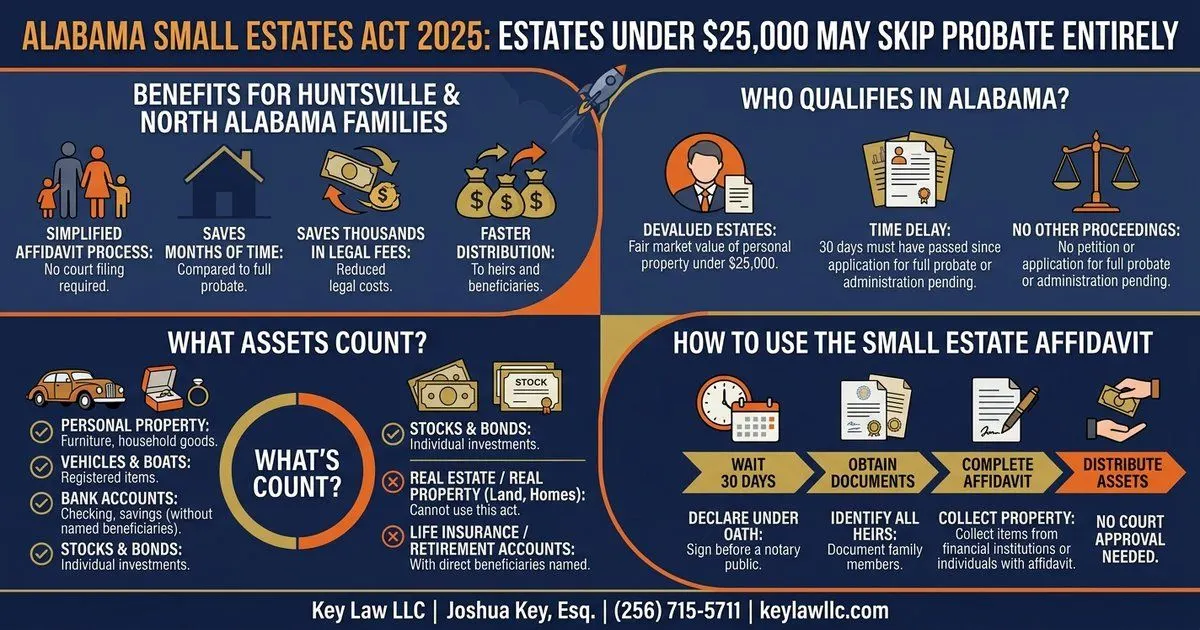
- Higher threshold: The limit increased from approximately $36,030 (2024) to approximately $47,000 (2025). The new threshold is tied to the combined homestead allowance, exempt property allowance, and family allowance under Alabama law, and adjusts automatically as those amounts change.
- Expanded court authority: The Probate Court is now authorized to manage the summary distribution process more directly, streamlining the procedure for eligible estates.
This means more Alabama families now qualify for summary distribution instead of full probate, saving significant time and money during an already difficult period.
Current Alabama Small Estate Threshold (2025)
As of October 1, 2025, the Alabama Small Estates Act threshold is approximately $47,000. This figure represents the combined value of three statutory allowances:
- Homestead allowance: $15,000 (for surviving spouse or dependent children)
- Exempt property allowance: Covers household furniture, automobiles, and personal effects
- Family allowance: Living expenses during administration
Because the threshold is tied to these allowances rather than a fixed number, it adjusts over time without requiring legislative action. The previous threshold was $36,030 in 2024, $29,014 in 2018, and has risen steadily with the Consumer Price Index.
Who Qualifies for Summary Distribution in Alabama?
To use the Alabama Small Estates Act summary distribution process, all of the following requirements must be met:
- The decedent was an Alabama resident at the time of death
- The total estate value is equal to or less than the combined statutory allowances (approximately $47,000 in 2025)
- There is no surviving minor child who is not also the child of the surviving spouse
- The decedent did not own real property that requires probate to transfer
- The petitioner is a rightful heir or surviving spouse
- No other petition for appointment of a personal representative is pending or has been granted
- The petition is filed in the county where the decedent resided
What Does Summary Distribution Cover?
Summary distribution covers personal property that would otherwise go through the probate estate:
- Bank accounts and investment accounts titled solely in the decedent’s name
- Vehicles (Alabama probate courts handle both estate matters and title transfers)
- Personal property, household goods, and valuables
- Business interests in some circumstances
What summary distribution does NOT cover: Real property (land, homes, commercial property) that is titled solely in the decedent’s name and requires a deed to transfer. That real estate must go through full probate or be handled through proper estate planning (such as a living trust or joint tenancy) before death.
How the Summary Distribution Process Works
The Alabama Small Estates Act summary distribution process involves these steps:
- File a verified Petition for Summary Distribution in the Probate Court of the county where the decedent lived, along with a certified death certificate and the original will (if one exists)
- Court publishes a notice of the petition in a local newspaper
- 30-day waiting period begins after publication
- Alabama Medicaid Agency is notified and given 30 days to respond (the Revised Act specifically requires this step)
- Once both 30-day periods pass and all conditions are confirmed, the Probate Judge approves the distribution
- Assets are distributed directly to heirs according to the court’s order, no personal representative appointment, no ongoing court oversight
The entire process typically takes 6 to 12 weeks from filing to completion, compared to 6 to 18 months or longer for a full probate administration.
Techniques to Qualify for the Alabama Small Estates Act
Sometimes an estate is close to qualifying but needs careful planning to get there. Several legitimate techniques can help:
- Use statutory allowances strategically: The homestead allowance ($15,000), exempt property allowance, and family allowance all pass to the surviving spouse or dependent children before the estate threshold calculation. These allowances have priority over creditor claims and are received on top of any inheritance share.
- Handle real property separately: If real estate was the only asset pushing the estate over the threshold, verify whether joint tenancy, beneficiary deed, or trust ownership means the property passes outside probate entirely. If so, the remaining estate may qualify for summary distribution.
- Confirm beneficiary designations: Life insurance, IRAs, 401(k)s, and accounts with payable-on-death designations pass directly to named beneficiaries outside of the probate estate entirely. They do not count toward the small estate threshold.
Alabama Small Estates Act: Frequently Asked Questions
What is the current Alabama Small Estates Act threshold in 2025?
Approximately $47,000 as of October 1, 2025, under the Revised Alabama Small Estates Act. The threshold is tied to the combined homestead allowance, exempt property allowance, and family allowance, and adjusts automatically as those values change. The previous threshold was $36,030 in 2024.
Does the Alabama Small Estates Act cover real estate?
No. Real property that is titled solely in the decedent’s name and requires a deed transfer must go through full probate administration. Summary distribution covers personal property only: bank accounts, vehicles, personal belongings, and similar assets. Real estate can avoid probate through a revocable living trust, joint tenancy with right of survivorship, or proper beneficiary deed planning done before death.
How long does summary distribution take in Alabama?
Typically 6 to 12 weeks from petition filing to final distribution order. The mandatory 30-day newspaper notice period and 30-day Medicaid notification period are the primary timeline drivers. This is significantly faster than full probate, which averages 6 to 18 months in Alabama.
Who can file a petition for summary distribution in Alabama?
The surviving spouse or a rightful heir (beneficiary under the will, or heir under Alabama intestate succession laws if there is no will) may file the petition. The petition must be filed in the Probate Court of the county where the decedent resided at the time of death.
What happens if the deceased had debts?
All creditor claims must be paid in full or by payment arrangement before summary distribution is granted. Funeral expenses must also be paid in full or under a payment plan. The Medicaid Agency gets 30 days to file a claim for any Medicaid benefits paid on behalf of the decedent before distribution is approved.
Does the 5-year Medicaid lookback apply to small estates?
The Medicaid lookback period applies to Medicaid planning and eligibility decisions made before death, not to the probate process itself. However, the Revised Alabama Small Estates Act specifically requires notification to the Alabama Medicaid Agency before summary distribution is approved, giving the state an opportunity to file a recovery claim against any Medicaid benefits paid on behalf of the decedent. This does not prevent summary distribution, it is simply a required notification step.
Can the Alabama Small Estates Act be used if the deceased had a will?
Yes. The Act applies to both testate (with a will) and intestate (without a will) estates, as long as the estate meets all other eligibility requirements. If the deceased left a will, the original will must be submitted to the Probate Court as part of the petition.
When Full Probate Is Still Required
Even with the expanded threshold under the Revised Act, full probate administration is required when:
- The total estate value exceeds approximately $47,000
- The decedent owned real property titled solely in their name that requires a deed transfer
- There are disputed creditor claims or heir disputes
- A minor child who is not the child of the surviving spouse survives the decedent
- A petition for appointment of a personal representative has already been filed or granted
In these situations, the estate needs full probate administration with a court-appointed personal representative, creditor notice publication, inventory filing, accounting, and final settlement hearing. An experienced Alabama probate attorney can significantly reduce the time and cost of that process.
The Better Solution: Estate Planning Before Death
The Alabama Small Estates Act is a useful tool when an estate qualifies, but it is a remedy for small estates that had no prior planning. For most Alabama families, a properly funded revocable living trust eliminates the need for probate entirely, regardless of estate size. The trust transfers assets immediately at death, without court involvement, creditor notice periods, or waiting.
A revocable living trust also covers real estate, which the Small Estates Act does not. For families with a home, investment property, or other real assets, a trust is the only complete probate-avoidance solution.
To learn more about trust planning options in Alabama, see Key Law’s estate planning overview.
Get Help With Alabama Probate or Estate Planning
Determining whether an estate qualifies for summary distribution, or whether full probate is required, involves a careful review of all assets, how they are titled, and the estate’s total value. Key Law LLC handles Alabama probate and estate planning matters across the state, including Madison County, Jefferson County, Marshall County, and surrounding areas.
Schedule a free discovery call to discuss a probate matter or to put the right estate plan in place before probate becomes a concern for your family.