The Alabama Slayer Rule: Can a Killer Inherit?
You named your spouse as the beneficiary on your life insurance policy twenty years ago. You never updated it after the separation. You never got around to changing your will. And then something unthinkable happens. Now your family is asking a question that sounds like it belongs in a crime drama, not a probate court: Can the person who caused your death inherit everything you left behind?
The Unthinkable Question Families Actually Face
Most people assume the justice system handles this. Murder is a crime. Criminal penalties follow. But the civil side, the estate side, runs on separate tracks. Alabama has specific laws that govern who inherits when someone dies. Those laws do not automatically exclude someone because they are accused of a crime. Until a court steps in, the named beneficiary on a life insurance policy or the spouse named in a will still has a claim on paper.
The stakes are high. Life insurance policies worth hundreds of thousands. Joint bank accounts. Real estate owned as joint tenants with right of survivorship. Each of these passes outside probate to the wrong person if no one acts. Families dealing with the aftermath of violence should not have to worry about the financial aftermath too. But they do. And the Alabama Legislature recognized this.
How Does the Alabama Slayer Rule Work?
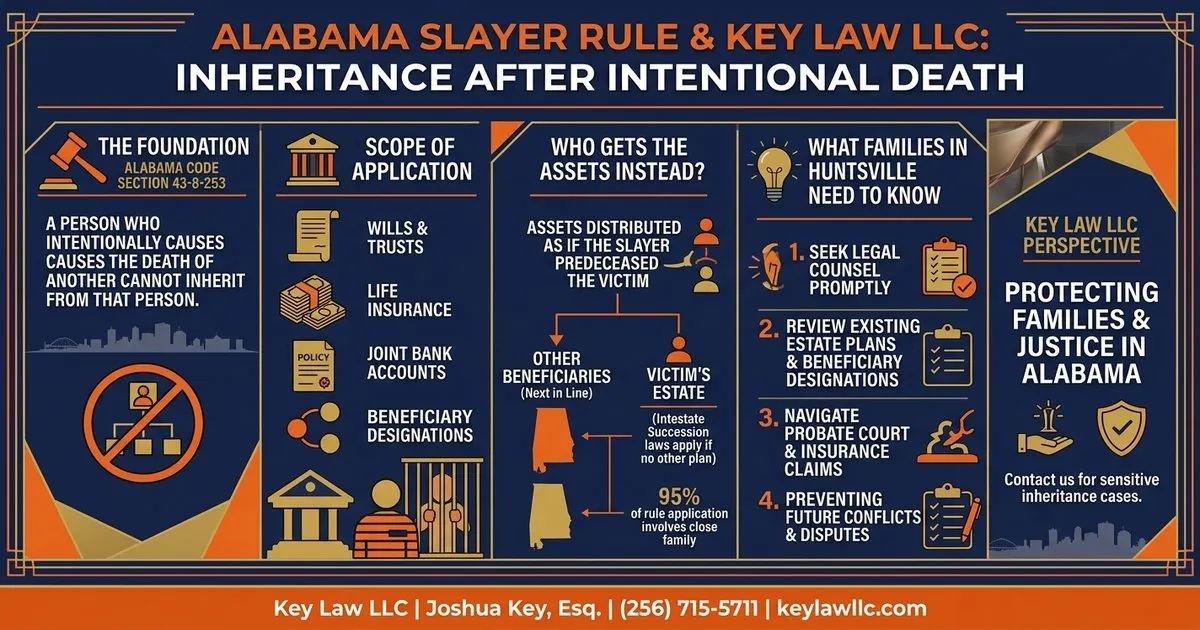
No. A convicted felonious killer cannot inherit from their victim in Alabama. Alabama Code § 43-8-253 explicitly bars any person convicted of feloniously killing the decedent from inheriting any part of the decedent’s estate. This applies to testate succession under a will, intestate succession when there is no will, and non-probate transfers like joint tenancy property, life insurance, and payable-on-death accounts.
For wills and intestate estates: The statute treats the killer as having predeceased the victim. The inheritance flows to the victim’s other heirs according to the will or Alabama’s intestacy laws found in § 43-8-41 through § 43-8-91.
For non-probate assets: The slayer rule overrides beneficiary designations. Even if the killer is named as beneficiary on a life insurance policy or retirement account, the proceeds go to contingent beneficiaries. If none are named, they pass according to the policy or account contract terms.
For jointly held property: The killer’s interest is severed and treated as having been owned by the victim alone. The killer gets nothing from joint accounts or property.
What Makes Alabama’s Slayer Rule Different?
Alabama Code § 43-8-253 creates a two-track system that gives families options. First, a criminal conviction automatically triggers the slayer rule. A felony conviction for killing the decedent is conclusive. The convicted killer is barred. End of story on the inheritance front.
But Alabama also recognizes that not every killer gets convicted. Charges get dropped. Juries acquit. Plea bargains happen. So § 43-8-253(e) allows the probate court to make an independent determination. If the probate court finds by a preponderance of the evidence that the heir feloniously and intentionally killed the decedent, the slayer rule applies. This civil standard is lower than criminal proof beyond a reasonable doubt.
Interestingly, an acquittal in criminal court does not automatically clear the heir in probate court. The probate judge applies the same preponderance standard to determine whether the killing was felonious and intentional. Alabama courts have upheld this distinction. The criminal and civil systems serve different purposes. One punishes. The other determines who gets property.
The Alabama provision also differs from federal law and from many other states in its scope. Some states only apply slayer rules to intentional killings. Alabama applies the rule to any felonious killing, which includes certain manslaughter convictions depending on the circumstances. This broader protection helps families who might otherwise see a reduced conviction allow someone to inherit. Alabama probate courts in the larger counties like Madison, Jefferson, and Montgomery have developed procedures for early intervention. They freeze distributions pending determination of slayer status. This prevents the wrong person from receiving assets only to have them clawed back later.
The Mistake That Blocks Wrongful Death Recovery
Here’s the trap. Families dealing with homicide often focus entirely on criminal proceedings. They want justice. They want the killer held accountable. But civil claims have deadlines. In Alabama, wrongful death claims under § 6-5-410 must be brought within two years of death. If the personal representative does not act, the claim is lost forever.
Wrongful death proceeds in Alabama are distributed to the heirs according to intestacy laws. The slayer is excluded from that distribution. But what families miss is that wrongful death damages are punitive in Alabama. The purpose is punishment and deterrence, not compensation. This means even if the estate has no economic losses, there is still substantial recovery available.
I’ve seen families so focused on the criminal case that they let the statute of limitations expire on civil claims. The killer might go to prison, but the family gets no financial recovery. That’s a second loss nobody needs.
What to Do Next
If your family is facing the intersection of homicide and estate administration, you need legal guidance now. Not after the criminal trial. Not after probate opens. Now. Evidence needs preserving. Claims need asserting. And the slayer rule needs invoking before assets transfer to the wrong person.
I work with families across Alabama who are handling these impossible situations. Not as a criminal defense attorney. As someone who protects the victim’s estate and the family’s financial future. Schedule a free 30-minute consultation or call (256) 715-5711. I’ll tell you exactly what needs to happen next.
Frequently Asked Questions
Can a killer inherit from their victim in Alabama?
No. Under Alabama Code § 43-8-253, a person who is convicted of feloniously killing the decedent is barred from inheriting any property, benefits, or interests from the victim’s estate. This applies to testate and intestate succession, as well as to joint tenancies, life insurance proceeds, and beneficiary designations.
What happens to the inheritance if the slayer is disqualified?
The property passes as if the killer predeceased the victim. For example, if a son kills his father, the son is treated as having died before the father. The inheritance would then flow to the victim’s other heirs according to their will or Alabama intestacy laws under § 43-8-41 through § 43-8-91.
Does the slayer rule apply to life insurance and retirement accounts?
Yes. Alabama Code § 43-8-253(b) specifically states that the slayer rule applies to any beneficiary designation, including life insurance policies, retirement accounts, payable-on-death accounts, and transfer-on-death registrations. The convicted killer cannot collect regardless of the contractual relationship.
What if there is no conviction, just an accusation?
Under Ala. Code § 43-8-253(e), a final judgment of conviction of a felonious and intentional killing is conclusive. If there is no such conviction, the court determines by a preponderance of the evidence whether the killing was felonious and intentional for purposes of the slayer rule.
How does the slayer rule intersect with wrongful death claims?
Wrongful death proceeds under Alabama Code § 6-5-410 are distributed to the victim’s heirs, which explicitly excludes the slayer. Additionally, wrongful death claims are punitive in Alabama and survive the victim’s death. The personal representative pursues these claims, but the killer does not benefit from them even if they are technically an heir at law.
Bottom line: Alabama’s slayer rule is designed to prevent the unjust enrichment of felonious killers. If your family is facing this situation, the time to act is now. Protecting the victim’s estate requires prompt legal action.