Your father passed away four months ago. The house is sitting empty. The bank won’t release the accounts. You’re paying the mortgage out of your own pocket because the estate checking account has a zero balance and the court hasn’t approved access yet.
This is probate in Alabama. It’s not broken. It’s working exactly as designed. That design is slow, expensive, and public.
What Should You Expect From Alabama Probate?
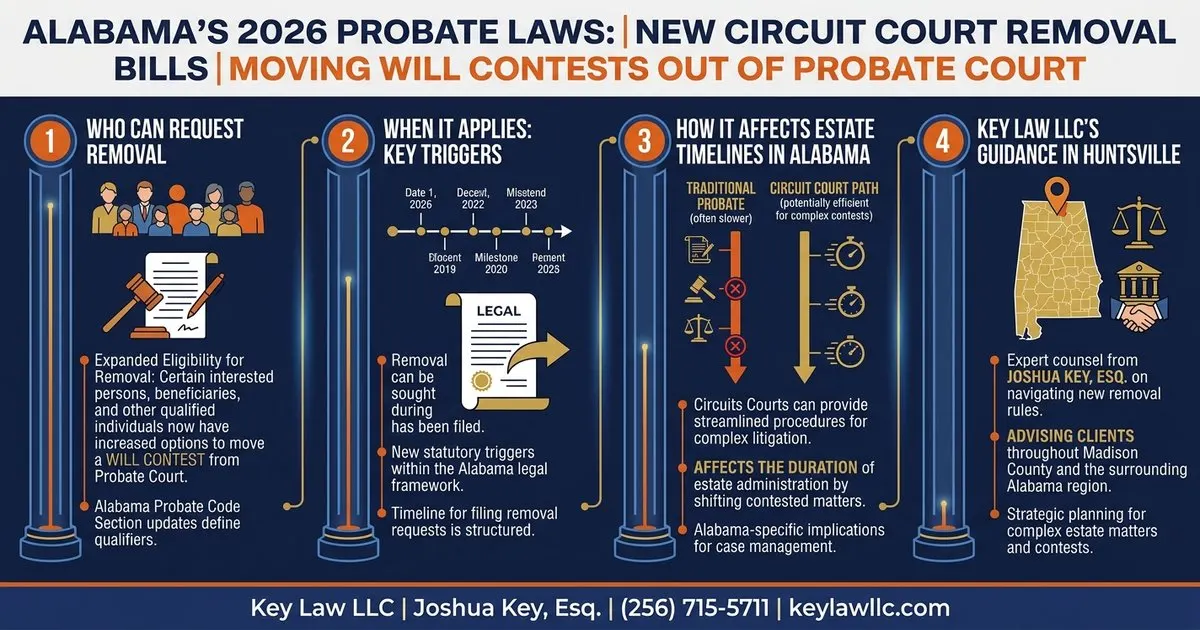
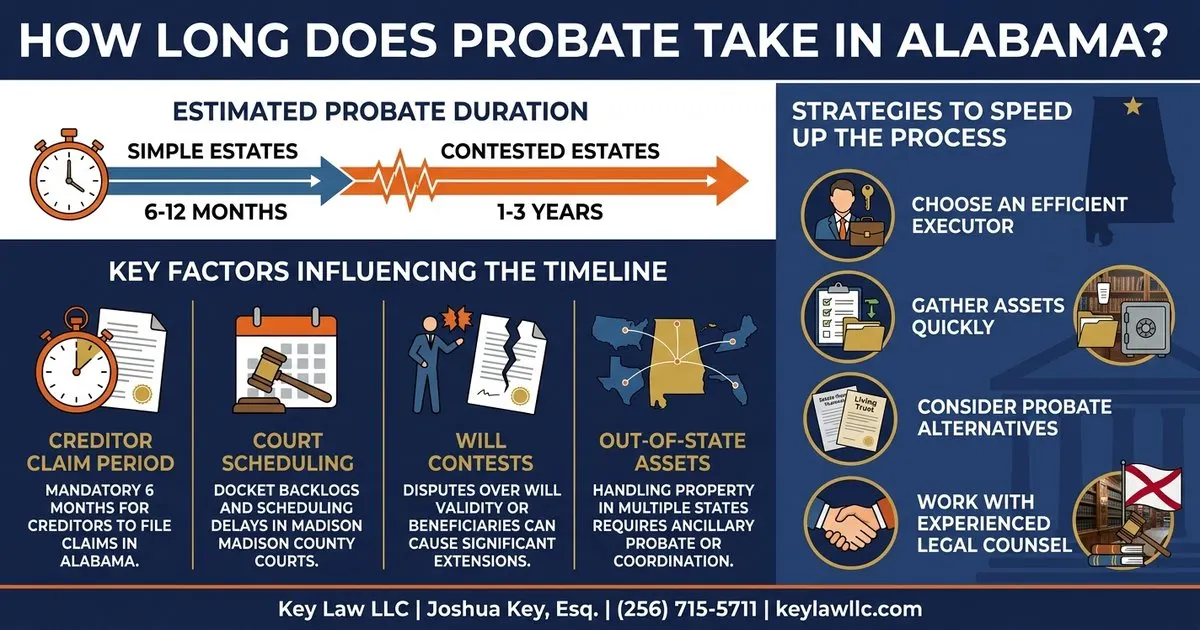
Here’s the honest answer nobody wants to give you. Alabama probate takes six months minimum, often a year, sometimes two.
The six-month floor isn’t negotiable. Alabama law requires probate to remain open for at least six months to allow creditors time to file claims. Even if your loved one had no debts, even if everyone agrees on everything, the court won’t close the estate before that window passes.
Realistic timelines I’ve observed:
Simple estates: 6-9 months. Clear will, no disputes, few assets, cooperative family.
Average estates: 9-12 months. House, bank accounts, some investments, standard complexity.
Complex estates: 12-24 months. Multiple properties, business interests, out-of-state assets, or tax issues.
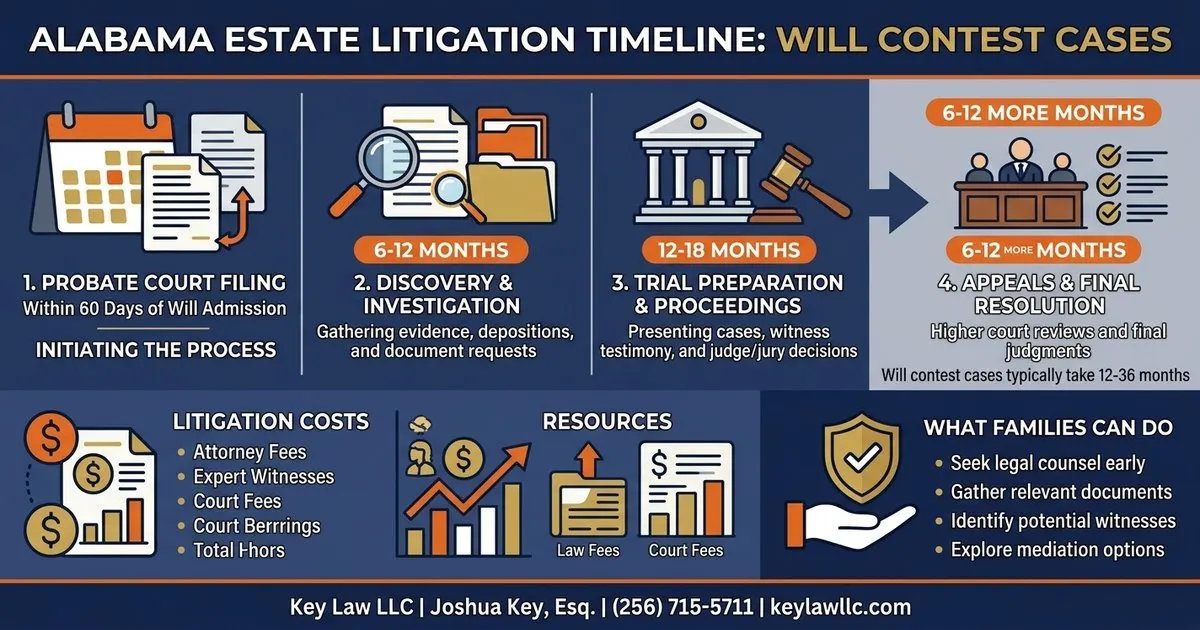
Contested estates: 2-5 years. Will challenges, family disputes, or creditor litigation.
I’ve seen a straightforward Huntsville estate take eight months. I’ve seen a contested Birmingham estate take four years. The variables matter more than the averages.
What Does the Executor Do, Step by Step?
Understanding the steps helps explain the timeline. Here’s what the executor does:
Month 1: File the will and petition with probate court. Get appointed as executor. Notify heirs and creditors. Publish notice in local newspaper.
Months 2-3: Inventory all assets. Get appraisals for real estate and valuables. Open estate checking account. Gather account statements and documentation.
Months 4-6: Wait for creditor claims period to expire. Pay valid debts. File tax returns if required. This is mostly waiting.
Months 7-9: Prepare accounting of all estate transactions. Get court approval for distributions. Transfer assets to beneficiaries.
Month 10+: File final accounting. Close the estate. Obtain discharge from court.
Each step has paperwork, deadlines, and court filings. Miss a deadline and the timeline extends. Make an error in the accounting and you’re back to the judge for correction.
Why Alabama Probate Takes Longer Than You Think
Several factors specific to Alabama extend probate timelines:
Creditor claims: That six-month window is mandatory. If a creditor files a claim in month five, the executor must evaluate, negotiate, or litigate. I’ve seen a single credit card dispute add four months.
Homestead issues: Alabama has specific rules about exempt homestead property. If the family home is involved, determining the exempt amount and handling it correctly takes extra court filings.
Spousal elections: Alabama allows surviving spouses to elect against the will and claim a statutory share. If this happens, everything pauses while the election is processed.
Tax clearance: The estate needs tax clearance letters from the IRS and Alabama Department of Revenue. Government timelines are unpredictable. I’ve waited three months for an IRS closing letter.
Multiple counties: If the deceased owned property in multiple Alabama counties, ancillary probate is required in each county. Each adds months.
The Cost of Waiting
Time isn’t the only cost. Probate expenses in Alabama typically run 3% to 5% of the estate’s total value.
On a $500,000 estate, that’s $15,000 to $35,000 in fees. Court costs, attorney fees, executor commissions, appraisals, publication fees. Money that would have gone to your family goes to the process instead.
Plus the hidden costs. Maintaining an empty house during probate. Paying utilities and insurance out of pocket because estate funds are frozen. Lost investment returns because accounts are tied up. Family stress from prolonged uncertainty.
I’ve watched siblings stop speaking to each other during a two-year probate. The process itself becomes the conflict.
How to Avoid Probate in Alabama
Probate isn’t mandatory. It’s the default for people who didn’t plan. Here are the alternatives:
Revocable living trust: Assets owned by the trust pass to beneficiaries immediately upon death. No court involvement. Privacy maintained. Timeline: weeks, not months.
Joint ownership with right of survivorship: Property automatically passes to the surviving owner. Common for married couples. Works for real estate and bank accounts.
Payable-on-death (POD) designations: Bank accounts transfer directly to named beneficiaries. Simple, free, effective.
Transfer-on-death (TOD) registrations: Securities and investment accounts pass directly to beneficiaries.
beneficiary designations: Life insurance, retirement accounts, and annuities pass outside probate to named beneficiaries. Critical: keep these updated.
Most families need a combination. The house in a trust. Bank accounts with POD. Investments with TOD. Life insurance with current beneficiaries.
What to Do Next
If you’re currently in probate, I cannot speed up the court system. But I will help you navigate it efficiently and avoid mistakes that extend the timeline.
If you’re planning ahead, let’s keep your family out of probate entirely. A revocable living trust, properly funded, eliminates the wait, the cost, and the public exposure.
Schedule a free 30-minute consultation. We’ll review your situation and build a plan that protects your family’s time and money. Call (256) 715-5711 or email contact@keylawllc.com.
Frequently Asked Questions
How long does probate take in Alabama?
Probate in Alabama typically takes 6 months to 2 years. Simple estates with clear assets and no disputes close in 4-6 months. Complex estates, contested wills, or tax issues extend probate to 18-24 months or longer. Alabama law requires probate to remain open for at least 6 months to allow creditors time to file claims.
What is the probate process in Alabama?
Alabama probate involves several steps: filing the will and petition with the probate court, appointing an executor or administrator, notifying heirs and creditors, inventorying assets, paying debts and taxes, distributing remaining assets to beneficiaries, and closing the estate. Each step has specific deadlines and requirements under Alabama law.
How much does probate cost in Alabama?
Probate costs in Alabama typically range from 3% to 7% of the estate’s total value. This includes court filing fees (usually $200-$500), attorney fees (often hourly or percentage-based), executor fees (up to 2.5% of estate value), appraisal costs, and publication fees for creditor notices. A $500,000 estate runs $15,000 to $35,000 in probate fees.
Is probate avoidable in Alabama?
Yes. Probate is avoidable in Alabama through several methods: revocable living trusts that own assets during life and transfer them at death, joint ownership with right of survivorship for real estate and accounts, payable-on-death (POD) designations for bank accounts, transfer-on-death (TOD) registrations for securities, and proper beneficiary designations on life insurance and retirement accounts.
What happens if someone dies without a will in Alabama?
If someone dies without a will in Alabama, their estate goes through intestate succession. The probate court appoints an administrator (usually a family member), and assets are distributed according to Alabama state law. Typically, the surviving spouse receives a portion, and children receive the remainder. If there is no spouse or children, parents, siblings, or more distant relatives inherit. The process often takes longer than probate with a will.
Do all estates have to go through probate in Alabama?
No. Small estates may qualify for Alabama’s summary distribution procedure under the Revised Alabama Small Estates Act, effective October 1, 2025. The threshold is no longer a fixed figure. It is tied to the combined homestead allowance, exempt property allowance, and family allowance, so it moves as those amounts are adjusted, and it is currently in the neighborhood of $47,000. Confirm the current figure before relying on it. Additionally, assets held in trust, accounts with beneficiary designations, jointly owned property with right of survivorship, and certain other assets pass outside probate directly to beneficiaries. Only assets titled solely in the deceased person’s name without beneficiaries require probate.