Your mother has been in the hospital for three weeks. The doctors say she needs skilled nursing care, maybe for months. The facility costs $7,200 a month. She has $80,000 in savings and owns her home free and clear.
You do the math. At this rate, her savings will be gone in eleven months. Then what?
This situation plays out constantly across Alabama. Families who worked their entire lives, saved responsibly, and suddenly face the prospect of losing everything to nursing home costs. The good news: Alabama law provides legal tools to protect assets. The catch: timing matters enormously.
How Much Does Long-Term Care Cost in Alabama?
Nursing home care in Alabama runs $6,500 to $8,000 per month. Assisted living is slightly less, but still substantial. Medicare covers only 100 days of skilled nursing following a hospital stay, and only if you’re improving. It does not cover custodial care, the help with bathing, dressing, and eating that most people eventually need.
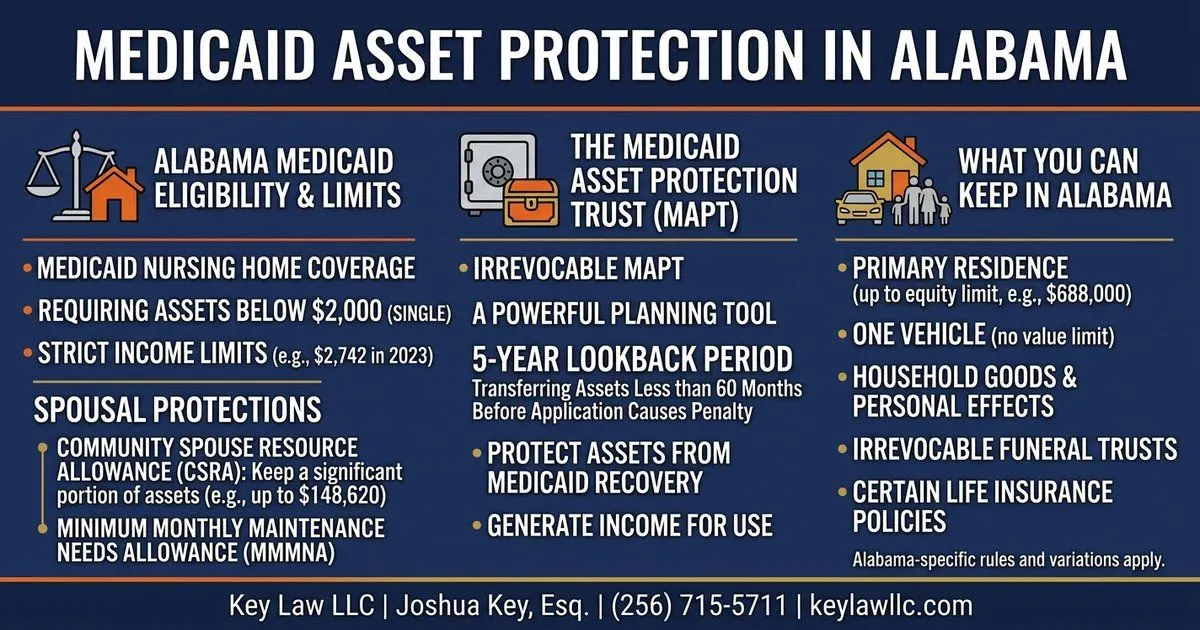
Medicaid picks up where Medicare stops, but qualifying requires spending down almost everything you own. For a single person in Alabama, that means $2,000 or less in countable assets. Your house is technically exempt while you’re alive, but Alabama Medicaid Estate Recovery places a lien on it after death.
I’ve watched families spend down $200,000, $300,000, even $500,000 before discovering there were legal ways to protect much of it.
How Does Medicaid Asset Protection Work?
Medicaid asset protection uses legal strategies to restructure how you own property so it doesn’t count toward Medicaid’s asset limits. The most common tool is an irrevocable trust, sometimes called a Medicaid trust or asset protection trust.
Here’s what happens: You transfer assets into a trust you cannot revoke or change. You name beneficiaries, usually your children. You keep the right to live in your home and receive income from trust assets, but you no longer legally own them.
After five years pass, those assets are protected. If you need Medicaid, the trust assets don’t count against you. They pass to your beneficiaries without going through probate or triggering estate recovery.
Key requirement: The five-year clock starts when you transfer assets, not when you apply for Medicaid. Wait too long, and the strategy won’t work.
What Makes Alabama Medicaid Rules Different?
Alabama’s Medicaid program follows federal guidelines but has state-specific rules that matter.
Asset limits: Single applicants can keep $2,000. Married couples have more flexibility. The healthy spouse, called the community spouse, keeps between $29,724 and $148,620 in countable assets, depending on total resources.
Home exemption: Your primary residence is exempt up to $713,000 in equity (as of 2025) if you intend to return home or if your spouse lives there. This exemption does not protect against estate recovery after death.
Transfer penalties: Alabama uses the average monthly cost of nursing facility care to calculate penalty periods. As of 2025, that figure is approximately $6,800. Transfer $68,000 improperly, and you face a 10-month penalty where Medicaid won’t pay.
Miller Trusts: Alabama is an income cap state. If your monthly income exceeds $2,901 (2025 limit), you won’t qualify for Medicaid even with no assets. A Qualified Income Trust, called a Miller Trust in Alabama, lets you redirect excess income into a trust so you qualify.
What Do Most Alabama Families Miss About Medicaid Planning?
The biggest mistake I see: waiting until there’s a crisis.
By the time someone is in the hospital facing discharge to a nursing facility, it’s usually too late for full asset protection. The five-year lookback period means gifts or transfers made within five years of applying trigger penalties.
But here’s what surprises people: even in crisis situations, I often protect some assets. Alabama allows certain transfers without penalty, including paying off debt, making home modifications for accessibility, and purchasing exempt resources like a vehicle or burial plot. Strategic spending in the right order can preserve tens of thousands.
The families who fare best are the ones who planned five years ahead. The families who fare second-best are the ones who called me the moment they realized long-term care was likely.
Why Does Giving Everything to Your Kids Backfire With Medicaid?
I get this question constantly. Why not put the house in your children’s names?
Families do this. But if you need Medicaid within five years, that transfer triggers a penalty. Your children also get your cost basis for capital gains tax purposes, meaning they’ll owe taxes on appreciation when they sell. And if a child divorces, gets sued, or dies before you, your house is now their asset, vulnerable to their creditors and ex-spouses.
A properly drafted trust avoids all three problems: no Medicaid penalty after five years, stepped-up basis at your death for tax purposes, and protection from your beneficiaries’ creditors.
What Should Alabama Families Do About Medicaid Planning Now?
If you’re over 60, have significant assets, or have a family history of dementia or long-term care needs, the time to plan is now. Not because you’re being pessimistic, because you’re being practical.
I offer free 30-minute consultations for Alabama families considering Medicaid asset protection. We’ll review your situation, discuss your goals, and outline whether planning makes sense for you. No pressure, no obligation.
Call (256) 715-5711 or email contact@keylawllc.com to schedule.
Schedule a free 30-minute consultation to review your Medicaid planning options. Call (256) 715-5711 or visit keylawllc.com.
Frequently Asked Questions
How much can you have in assets and still qualify for Medicaid in Alabama?
In Alabama, a single person can have no more than $2,000 in countable assets to qualify for Medicaid long-term care. For married couples, the healthy spouse can keep between $29,724 and $148,620 in assets, depending on total resources. Your primary home is usually exempt if you plan to return or if your spouse lives there.
What is the 5-year lookback period for Medicaid in Alabama?
Alabama Medicaid looks back 5 years from your application date to review any asset transfers. Gifts or transfers for less than fair market value during this period can trigger a penalty period where you’re ineligible for benefits. The penalty is calculated based on the amount transferred divided by the average monthly cost of nursing home care in Alabama.
Can Medicaid take your house in Alabama?
Medicaid cannot take your house while you’re alive if you intend to return home or if your spouse, minor child, or disabled child lives there. Alabama Medicaid Estate Recovery places a lien on your home after death to recover benefits paid. Proper planning with an irrevocable trust or life estate protects your home from estate recovery.
How much does nursing home care cost in Alabama?
Nursing home care in Alabama averages $6,500 to $7,500 per month. Private pay rates in Huntsville and Birmingham often exceed $8,000 monthly. Without planning, a 3-year stay can consume $250,000 or more in savings. Medicaid covers these costs once you qualify, which is why asset protection planning is essential.
What is a Medicaid asset protection trust in Alabama?
A Medicaid asset protection trust is an irrevocable trust that removes assets from your estate so they don’t count toward Medicaid limits. In Alabama, you must create and fund the trust at least 5 years before applying for Medicaid. Once the lookback period passes, those assets are protected and won’t affect your eligibility.
Should I start Medicaid planning if I am healthy?
Yes. The 5-year lookback period means you need to plan well before you need care. If you wait until a health crisis, it is too late to protect assets through trust strategies. The ideal time to start Medicaid planning is in your 60s, while you are healthy and have time for the lookback period to expire. Families who plan early preserve significantly more wealth than those who react to a crisis.