Alabama Probate vs Non-Probate Assets: Which of Your Assets Go Through Court?
A client sat across from me last month holding a stack of account statements. Her father had died six weeks earlier. She assumed the will settled everything. Instead, she was learning a difficult lesson: some assets transferred to her in days, and others were stuck in probate court for the foreseeable future.
Her father’s IRA had already moved into her name. His life insurance paid out within two weeks. But his checking account was frozen. His brokerage account would not release a penny. His house, the one he owned free and clear for thirty years, required court approval to sell.
The difference had nothing to do with the will. It had everything to do with how each asset was set up during his lifetime. Some assets are built to transfer automatically at death. Others are not. Knowing which is which is one of the most practical things you will ever learn about your own estate.
What Makes an Asset a Probate Asset in Alabama?
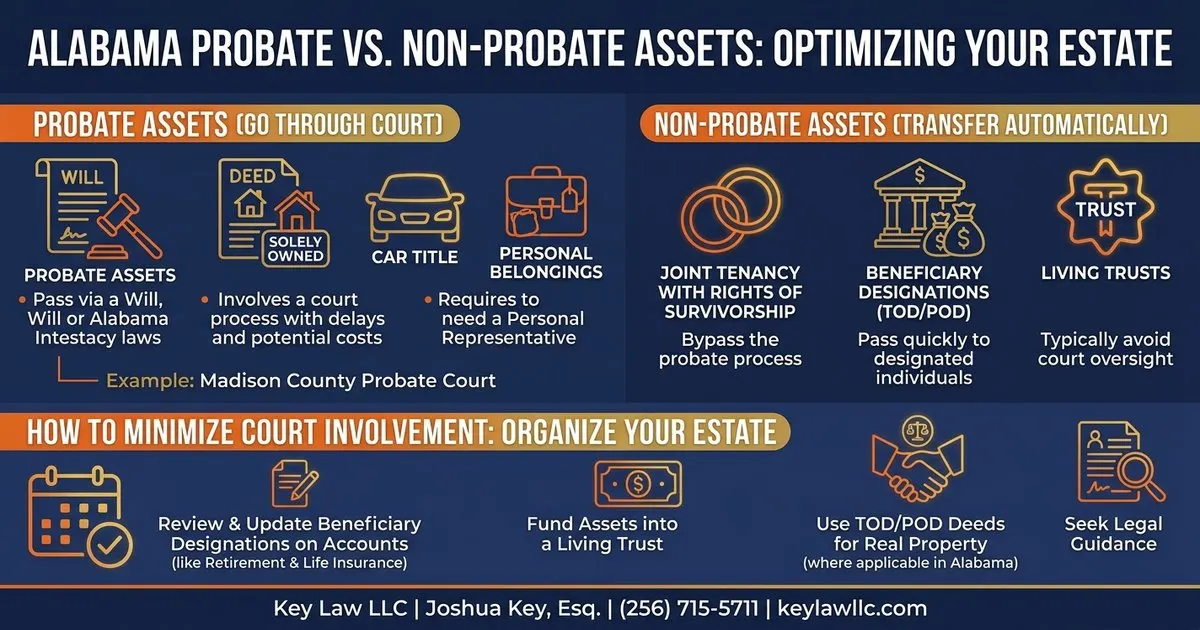
A probate asset is anything titled solely in your name that has no built-in mechanism to transfer at death. When you die, there is no contractual instruction telling the bank, the brokerage, or the county recorder who gets it next. The only way to move that asset to someone else is through probate court.
The probate court reviews your will, confirms it is valid, appoints an executor, and oversees the transfer. If you had no will, the court applies Alabama’s intestacy laws to determine who receives what. Either way, the court is involved.
Here is what typically falls into the probate category in Alabama:
Real estate titled only in your name. If the deed shows you as the sole owner, with no survivorship language, that property goes through probate. This is true whether the property has a mortgage or is paid off. The mortgage does not determine whether probate is required. Title determines it.
Bank accounts in your name alone. A standard checking or savings account with no payable-on-death designation is a probate asset. The bank will freeze it the moment they learn of your death. Your executor will need court authorization (called Letters Testamentary) to access those funds.
Investment and brokerage accounts without TOD registration. Same principle. If the account has no transfer-on-death beneficiary on file, the brokerage firm will not release assets without a court order.
Vehicles titled in your name alone. Cars, trucks, boats, and other titled property follow the same rule. No survivorship on the title means probate.
Personal property. Furniture, jewelry, collectibles, tools, artwork. Anything without a contract directing its transfer at death falls into the probate estate.
Business interests held individually. If you are the sole owner of an LLC or hold stock in a closely held corporation with no transfer mechanism, those interests go through court.
What Makes an Asset a Non-Probate Asset?
Non-probate assets have a built-in instruction for what happens at death. That instruction comes from a contract (like a beneficiary designation), a form of ownership (like joint tenancy with survivorship), or a legal arrangement (like a trust). The asset transfers automatically. The probate court has no role.
Here is what typically falls outside probate in Alabama:
Life insurance with a named beneficiary. The insurance company pays the named beneficiary directly. The proceeds never enter the probate estate. This is why life insurance is often the first money a family receives after a death.
Retirement accounts with designated beneficiaries. 401(k)s, IRAs, 403(b)s, and pensions with beneficiary designations on file transfer directly to those beneficiaries. The plan administrator handles the transfer without court involvement.
Payable-on-death (POD) bank accounts. If you complete a POD form at your bank naming a beneficiary, that person presents a death certificate and receives the funds. No probate. No waiting for court authorization.
Transfer-on-death (TOD) brokerage accounts. Similar to POD designations, a TOD registration on an investment account directs the brokerage to transfer assets to your named beneficiary at death.
Joint tenancy with right of survivorship. When two people own property as joint tenants with survivorship rights, the surviving owner automatically becomes the sole owner at the first death. The survivor files an affidavit of survivorship to update title records, but no probate proceeding is needed.
Assets held in a living trust. Property transferred into a revocable living trust during your lifetime passes according to the trust terms. The successor trustee distributes assets without court oversight.
A note on transfer-on-death deeds. Alabama does not have one. The state has never adopted the Uniform Real Property Transfer on Death Act, so a deed drafted to transfer real estate at death has no legal effect here. For Alabama real property, the two options above, joint tenancy with right of survivorship and a properly funded revocable living trust, are the ones that work.
Why Does This Distinction Matter So Much?
Time and cost. Probate in Alabama typically takes six to twelve months at minimum. Contested estates take longer. During that period, probate assets are largely frozen. Your family waits for court authorization before they sell the house, access bank funds, or liquidate investments.
Non-probate assets, by contrast, often transfer within days or weeks. The life insurance check arrives. The IRA rolls over. The POD account releases funds. Your family has liquidity when they need it most.
Cost is the other factor. Probate involves court filing fees, executor commissions, legal fees, and sometimes appraisal costs. On a $500,000 estate, those costs range from $15,000 to $40,000 depending on complexity. Non-probate transfers cost little or nothing to execute.
There is also the privacy issue. Probate is a public proceeding. Anyone who walks into the Madison County Probate Court or searches online records sees what you owned and who received it. Non-probate transfers are private. No public record of the transfer exists beyond what the parties choose to disclose.
Where Do People Get This Wrong?
The most common mistake I see is the assumption that the will controls everything. It does not. The will only governs probate assets. Non-probate assets follow their own rules, regardless of what the will says.
I worked with a family where the father’s will left his entire estate equally to three children. But his $300,000 brokerage account had a TOD designation naming only the oldest child. That child received the full $300,000. The other two received nothing from that account. The will was irrelevant because the TOD designation controlled.
The reverse is also true. A client told me she did not need a will because all of her accounts had beneficiary designations. But she forgot about her house, her car, and a storage unit full of antique furniture. Those assets had no transfer mechanism. They went through probate, and without a will, Alabama’s intestacy laws determined who received them.
Another common error is outdated ownership. A widow still had her late husband’s name on the house deed as joint tenants with survivorship. She assumed the house was in her name because he had died ten years earlier. Technically, she owned it, but the title records had never been updated. When she died, her children faced confusion and extra paperwork because the chain of title was unclear.
Tenants-in-common ownership is another area of confusion. Joint tenancy with right of survivorship passes outside probate. Tenancy in common does not. If you and your sibling own a lake house as tenants in common and your sibling dies, their share goes through their probate estate. It does not automatically become yours. The form of co-ownership matters.
How Does Alabama Law Handle Specific Situations?
Alabama follows its own version of probate and property law, with some features worth understanding.
Alabama has not adopted the Uniform Real Property Transfer on Death Act. Many states allow a transfer-on-death deed for real estate. Alabama is not one of them, and a deed drafted to pass property at death has no legal effect here. That leaves title as the deciding factor for Alabama real estate: the two ways to keep a house out of probate are joint tenancy with right of survivorship and a properly funded revocable living trust.
Under Ala. Code section 43-2-692, a small estate may qualify for summary distribution. This is a petition to the probate court, with published notice and a court order under section 43-2-693, not a self-executing affidavit. Under the Revised Alabama Small Estates Act, effective October 1, 2025, the threshold is no longer a fixed figure. It is tied to the combined homestead allowance, exempt property allowance, and family allowance, so it moves as those amounts are adjusted, and it is currently in the neighborhood of $47,000. Summary distribution does not reach real property that requires a deed transfer, and it is unavailable if someone has already opened a probate case.
Alabama requires executors to publish notice to creditors after a probate case opens. Creditors then have until the later of six months after the grant of letters or five months after the first publication of notice to file claims, and any creditor entitled to actual notice must be allowed thirty days after that notice. Ala. Code section 43-2-350. This waiting period is one reason probate takes so long. Executors who distribute assets before the creditor period expires risk personal liability under Alabama law.
For non-probate assets, Alabama banks and credit unions generally honor POD designations without extensive delay. Some institutions require a brief waiting period or an affidavit from the beneficiary, but the process is far faster than probate.
What Should You Do With This Information?
Pull out every account statement and property deed you own. For each one, answer two questions. First: how is this titled? Second: is there a beneficiary designation or survivorship provision on file?
If the answer to the second question is no, that asset will go through probate when you die. You then decide whether that is acceptable or whether you want to add a transfer mechanism.
For bank accounts, adding a POD designation is free and takes ten minutes at the branch. For brokerage accounts, adding a TOD registration is a one-page form. For real estate, a transfer into a living trust requires some legal work but eliminates probate for your most valuable asset.
The goal is not to eliminate probate entirely. Some assets are fine going through court. The goal is to make sure you know which assets fall where, so your family is not blindsided by frozen accounts and court delays when they are already dealing with a loss.
Schedule a free 30-minute consultation and bring your account list. I will walk through each asset with you and identify which ones need attention. Most clients finish this review in a single session.
Frequently Asked Questions
What assets go through probate in Alabama?
Assets titled solely in the deceased person’s name go through probate in Alabama. This includes real estate with no survivorship deed, bank accounts without payable-on-death designations, investment accounts without transfer-on-death registrations, personal property like vehicles and jewelry, and individually held business interests. These assets need court approval to change ownership after death.
What assets pass outside of probate in Alabama?
Non-probate assets transfer automatically at death without court involvement. These include life insurance with named beneficiaries, retirement accounts with designated beneficiaries, payable-on-death bank accounts, transfer-on-death brokerage accounts, joint tenancy property with right of survivorship, and assets held in living trusts. Alabama does not recognize transfer-on-death deeds for real estate.
Does a will control all of my assets in Alabama?
No. A will only controls probate assets. Non-probate assets pass by contract or by operation of law, regardless of what the will says. If a life insurance policy names your brother as beneficiary, your brother receives the proceeds even if your will leaves everything to your spouse. The beneficiary designation controls, not the will.
Is a house a probate asset in Alabama?
A house is a probate asset if it is titled solely in the deceased person’s name, regardless of whether a mortgage exists. If the house is held in joint tenancy with right of survivorship or in a living trust, it passes outside probate. Alabama does not recognize transfer-on-death deeds for real estate. How you hold title determines whether the house goes through court.
What is the small estate threshold in Alabama?
Under Ala. Code section 43-2-692, a small estate may qualify for summary distribution, which is a petition to the probate court with published notice and a court order under section 43-2-693 rather than a self-executing affidavit. Under the Revised Alabama Small Estates Act, effective October 1, 2025, the threshold is tied to the combined homestead, exempt property, and family allowances rather than a fixed figure, so it moves. It is currently in the neighborhood of $47,000. Confirm the current figure before relying on it. Summary distribution does not reach real property requiring a deed transfer, and it is not available if a full probate has already been opened.
What happens to joint tenancy property when one owner dies in Alabama?
Property held in joint tenancy with right of survivorship automatically passes to the surviving joint tenant at death. No probate is required. The survivor files an affidavit of survivorship with the probate court to update the title records. This applies to real estate, vehicles, and financial accounts held with survivorship rights.