
You spent $3,000 on an estate plan. Your attorney drafted a will that divides everything equally between your two children. You signed it, felt the relief of having your wishes documented, and put the originals in your safe. Then you died. Your $500,000 life insurance policy paid out completely to your ex-wife (see also: Alabama’s new inheritance protection laws).
Your children got nothing from that policy. Your will did not matter. The beneficiary designation you filled out fifteen years ago during your first marriage controlled everything.
This happens regularly in Alabama. beneficiary designations on life insurance, retirement accounts, and payable-on-death bank accounts operate outside your will. This is one of the most common probate complications in Alabama. They trump everything else. A form you filled out in five minutes at your kitchen table overrides estate planning documents that took months to create.
This article explains how beneficiary designations work, why they override your will, the specific mistakes Alabama families make, and how to coordinate these forms with your overall estate plan.
What Happens When Beneficiary Forms Are Outdated?
Estate planning attorneys see this pattern constantly. A client creates a perfect plan. The will distributes assets equally. The trust provides for minor children. The powers of attorney name the right agents. Every document reflects current wishes. Then I find the life insurance still names the ex-spouse. The 401(k) lists a parent who died three years ago. The bank account names only one child as payable-on-death beneficiary.
The result: the estate plan fails. Assets pass to the wrong people. Family relationships fracture. Litigation follows.
Consider a typical scenario I see in my Huntsville practice:
A father remarries after his first wife’s death. He creates a new will leaving everything to his second wife, with his children from the first marriage as contingent beneficiaries. He intends to treat everyone fairly. But he never updates the beneficiary designation on his $400,000 IRA from his first marriage. It still names his deceased first wife, with his children as contingent beneficiaries.
When he dies, the IRA passes directly to his children. They receive $400,000 outside the will. His second wife gets the house and bank accounts, totaling $200,000. The children, already estranged, refuse to share. The second wife sues, claiming the father intended equal treatment. The litigation costs $50,000 and destroys family relationships.
All because of a form filled out twenty years ago.
The financial damage extends beyond family conflict. Incorrect beneficiary designations trigger:
- Unexpected tax consequences (income tax on inherited retirement accounts)
- Loss of stretch provisions for inherited IRAs
- Disqualification from Medicaid for surviving spouses
- Creditor claims against inherited assets
- Special needs benefit disruptions for disabled beneficiaries
For pilots and frequent travelers, the risk increases. You manage accounts across multiple states, employer plans, and professional associations. Each account has its own beneficiary form. Keeping them coordinated requires systematic attention.
How Do Beneficiary Designations Work?
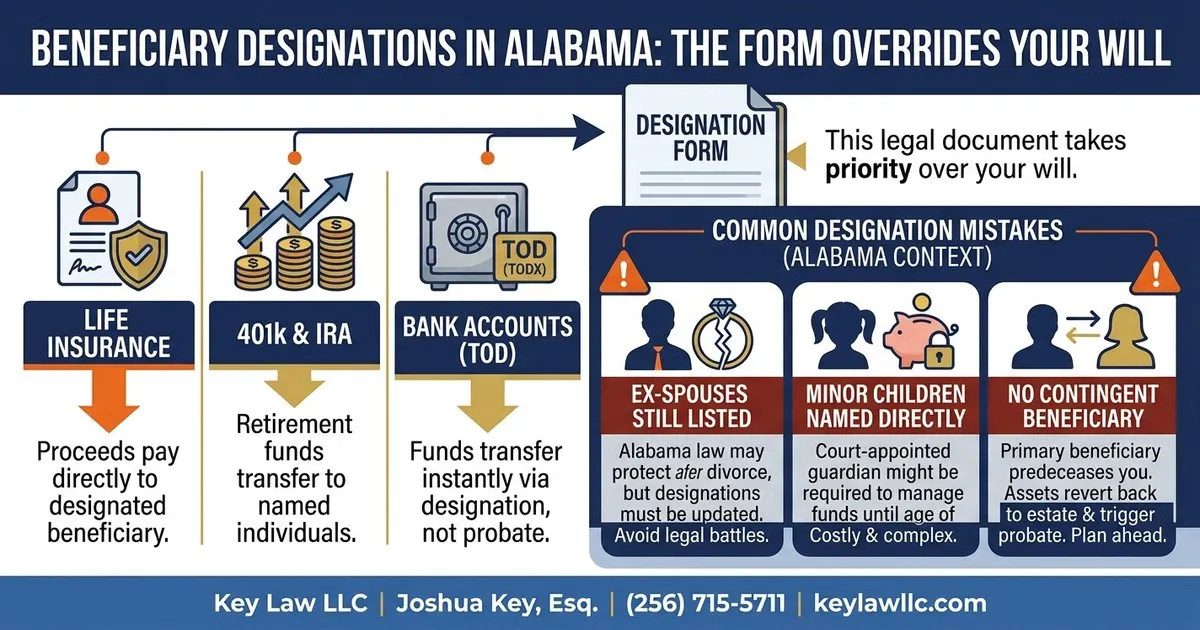
Beneficiary designations are contractual instructions between you and a financial institution. When you name a beneficiary, you create a direct transfer arrangement that operates independently of your will.
What they are: Legal instructions telling a financial institution who should receive an asset upon your death.
What they do: Transfer assets directly to named beneficiaries without probate court involvement.
Why they matter: They provide immediate access to funds for beneficiaries and keep assets out of probate. But they also bypass your will entirely.
Common accounts with beneficiary designations include:
- Life insurance policies: Primary and contingent beneficiaries named on the policy application
- Retirement accounts: 401(k), 403(b), IRA, TSP, and pension beneficiaries
- Payable-on-death accounts: Bank accounts with POD designations
- Transfer-on-death registrations: Investment accounts and securities
- Annuities: Primary and secondary beneficiaries
- Employer benefits: Group life insurance, accidental death policies
The transfer happens automatically. When the financial institution receives proof of death, they distribute the asset to the named beneficiary. No court order required. No probate process. No reference to your will.
This efficiency creates the risk. The financial institution follows the form, not your intent. If the form is outdated, the wrong person receives the asset.
How Do Alabama Spousal Rights Affect Beneficiary Designations?
Alabama is not a community property state. This affects how beneficiary designations work for married couples.
In community property states like California or Texas, spouses own marital property equally. Retirement accounts accumulated during marriage are typically community property, requiring spousal consent for beneficiary changes. Alabama follows common law property rules. Each spouse owns what is in their name individually.
Alabama does give surviving spouses important protections that interact with beneficiary designations:
Elective share rights: Under Ala. Code § 43-8-70, a surviving spouse claims an elective share of the deceased spouse’s estate if dissatisfied with the will. This applies to probate assets. Assets passing by beneficiary designation generally do not count toward the elective share calculation, though these sometimes affect the calculation in certain circumstances.
Homestead exemption: Alabama’s homestead exemption protects the family home from creditor claims (Ala. Code § 6-10-6). If a house passes by beneficiary designation or transfer-on-deed, the exemption still applies.
Exempt property allowance: Surviving spouses and minor children are entitled to certain exempt property from the estate, including household furniture and personal effects (Ala. Code § 43-8-70). This operates alongside beneficiary designations.
Pretermitted spouse statute: If you marry after executing a will that names beneficiaries other than your new spouse, Alabama law sometimes gives your spouse a share of your estate (Ala. Code § 43-8-90). This typically applies to probate assets, not assets with valid beneficiary designations.
For Alabama families, the key takeaway: beneficiary designations provide efficient transfers but sometimes inadvertently disinherit a spouse or create unequal treatment among children. Coordination with your overall estate plan is essential.
Why Do Most People Miss Contingent Beneficiaries?
The single biggest mistake we see: naming only primary beneficiaries and ignoring contingent beneficiaries.
Primary beneficiaries receive the asset if they survive you. Contingent beneficiaries receive the asset only if the primary beneficiary does not survive you. Most people fill out the primary beneficiary line and stop. They leave the contingent beneficiary section blank.
This creates a massive gap. If your primary beneficiary dies before you, and you have not named a contingent beneficiary, the asset typically passes to your estate. This means probate. This means your will controls. This means the asset might go to someone you did not intend.
Consider this scenario:
You name your spouse as primary beneficiary of your $300,000 life insurance policy. You leave the contingent beneficiary blank. Your spouse dies in a car accident. Six months later, you die. Because your primary beneficiary predeceased you and you named no contingent beneficiary, the $300,000 passes to your estate.
Your will leaves everything equally to your three children. But your will is five years old. It was written before your youngest child was born. It names only your two older children. Your youngest child inherits nothing from the life insurance.
The solution: always name contingent beneficiaries. Name multiple levels if possible:
- Primary: Spouse
- Contingent: Children equally
- Second contingent: Trust for grandchildren
Review these designations annually. Update them after every major life event: marriage, divorce, birth, death, estrangement. A five-minute review prevents catastrophic outcomes.
What Should You Do About Your Beneficiary Designations Now?
Pull out your estate planning documents. Then gather every beneficiary designation form you have ever signed. Compare them. Look for mismatches between your current wishes and the forms on file.
Common mismatches we find:
- Ex-spouses still named on life insurance
- Deceased parents named as contingent beneficiaries
- Only one child named on a POD account when the will says equal distribution
- No contingent beneficiaries named anywhere
- Trust named as beneficiary on retirement accounts (sometimes problematic)
If you find conflicts, update the forms immediately. Contact each financial institution. Request current beneficiary designations. Complete new forms if needed. Keep copies with your estate planning documents.
If you are unsure whether to name your trust as beneficiary, consult an attorney. The decision involves tax considerations, distribution timing, and creditor protection. The wrong choice costs your beneficiaries thousands in unnecessary taxes.
I help Alabama families coordinate beneficiary designations with their estate plans. A 30-minute review identifies conflicts before they become family disasters. Call (256) 715-5711 or schedule online at keylawllc.com/scheduleasession/.
Frequently Asked Questions
Do beneficiary designations override a will in Alabama?
Yes. Beneficiary designations on life insurance, retirement accounts, and payable-on-death accounts override your will. These assets pass directly to the named beneficiary regardless of what your will says. This is true in Alabama and every other state.
What happens if I don’t name a beneficiary?
If you do not name a beneficiary, most accounts default to your estate. This means the asset goes through probate and distributes according to your will or Alabama intestate succession laws. For retirement accounts, the plan document usually specifies default beneficiaries, often your spouse or children.
Should I name my trust as beneficiary?
Naming your trust as beneficiary has real benefits: controlled distributions for minor children, protection from creditors, and management for beneficiaries who need help handling money. But it sometimes accelerates required distributions from retirement accounts. The right choice depends on your situation and requires an attorney’s guidance.
How often should I update beneficiary designations?
Review beneficiary designations annually and after major life events: marriage, divorce, birth of children, death of a beneficiary, or significant changes in relationships. Many people update their will but forget to update beneficiary forms, creating conflicting instructions.
Should I name minor children as beneficiaries?
Naming minor children as beneficiaries creates problems. In Alabama, minors cannot legally own property outright. If a minor inherits directly, the court appoints a guardian to manage the assets until age 19. Naming a trust as beneficiary for minor children avoids court involvement and lets you choose who manages the inheritance.
What happens if my beneficiary dies before me?
If your primary beneficiary dies before you and you named a contingent beneficiary, the asset passes to the contingent beneficiary. If you named no contingent beneficiary, the asset typically passes to your estate and goes through probate. This is why naming multiple levels of beneficiaries matters.